
Search
News & Blog
Categories
Have Any Question?
Do not hesitage to give us a call. We are an expert team and we are happy to talk to you.
 +84 914 544 660 (WhatsApp)
 info@vietnamcatholictours.com
The 21 European Missionary Saints Among the 117 Vietnamese Martyrs
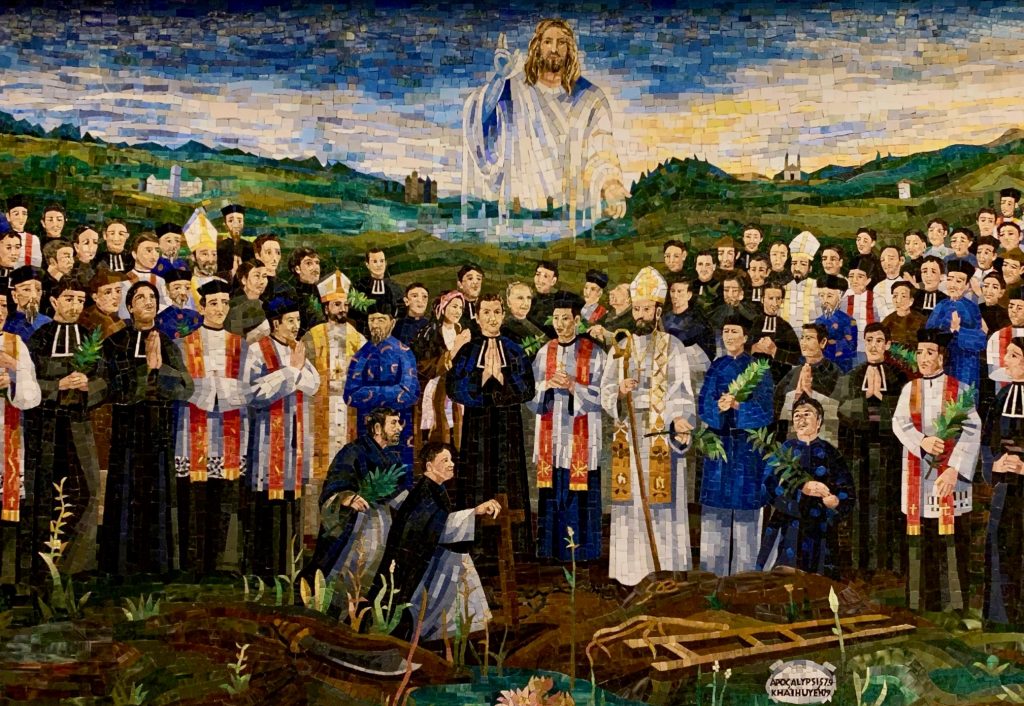
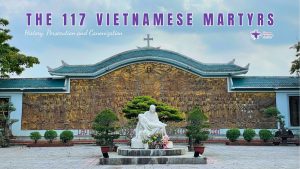
The “117 Vietnamese Martyrs” is the collective title commonly used for the group of 117 martyrs canonized together by Pope St. John Paul II on June 19, 1988. Despite the name, not all 117 were Vietnamese by nationality: 96 were Vietnamese, while 21 were European missionaries from Spain and France.
Among the 117 Vietnamese Martyrs are 21 missionaries whose journeys began thousands of kilometers from Vietnam.
Eleven came from Spain and belonged to the Order of Preachers (Dominicans). Ten came from France and belonged to the Paris Foreign Missions Society (MEP). Together, they included eight bishops and thirteen priests.
They left Europe for missionary service in Asia and devoted themselves to serving the Church in Vietnam, where they ultimately gave their lives for the faith. Their stories form a remarkable chapter in the history of the Catholic Church in Vietnam.
Who were these 21 European missionaries, and how did their journeys from Europe become part of Vietnam’s Catholic history?
The 21 European Missionary Saints at a Glance
| Missionary Group | Saints | Bishops |
Priests |
|
Spanish Dominicans |
11 | 6 |
5 |
|
French MEP missionaries |
10 | 2 |
8 |
| Total | 21 | 8 |
13 |
The 11 Spanish Dominican Martyrs
The 11 Spanish missionary saints were all members of the Order of Preachers (Dominicans). They included six bishops and five priests.
|
Saint |
Ministry | Year of Martyrdom |
| St. Francisco Gil de Federich | Priest |
1745 |
|
St. Mateo Alonso de Leciniana |
Priest |
1745 |
| St. Jacinto Castañeda | Priest |
1773 |
| St. Domingo Henares | Bishop |
1838 |
|
St. Ignacio Clemente Delgado Cebrián |
Bishop | 1838 |
|
St. José Fernández |
Priest |
1838 |
| St. José María Díaz Sanjurjo | Bishop |
1857 |
|
St. Melchor García Sampedro |
Bishop | 1858 |
| St. Jerónimo Hermosilla | Bishop |
1861 |
| St. Valentín Berrio-Ochoa | Bishop |
1861 |
| St. Pedro Almató | Priest |
1861 |
Their stories span more than a century. Pope St. John Paul II identified St. Francisco Gil de Federich as the first Spanish martyr in Vietnam and St. Pedro Almató as the last.
One particularly meaningful story is that of St. Jacinto Castañeda, who was martyred in 1773 together with the Vietnamese Dominican priest St. Vincent Lê Quang Liêm.
One was Spanish and the other Vietnamese, but both were Dominican priests and shared the same martyrdom. Their shared martyrdom reflects the deep bonds of faith that had developed between European missionaries and Vietnamese Catholics.
The 10 French Martyrs of the Paris Foreign Missions Society
The other ten European saints came from France and belonged to the Paris Foreign Missions Society, commonly known by its French abbreviation, MEP (Missions Étrangères de Paris).
They included two bishops and eight priests.
|
Saint |
Ministry | Year of Martyrdom |
|
St. François-Isidore Gagelin |
Priest | 1833 |
| St. Joseph Marchand | Priest |
1835 |
|
St. Jean-Charles Cornay |
Priest | 1837 |
| St. François Jaccard | Priest |
1838 |
|
St. Pierre-Rose-Ursule Dumoulin-Borie |
Bishop | 1838 |
|
St. Augustin Schoeffler |
Priest |
1851 |
| St. Jean-Louis Bonnard | Priest |
1852 |
|
St. Pierre-François Néron |
Priest | 1860 |
| St. Théophane Vénard | Priest |
1861 |
| St. Étienne-Théodore Cuénot | Bishop |
1861 |
Like the Spanish Dominicans, these French missionaries left Europe to serve the Church in Asia. Their missionary journeys eventually brought them to Vietnam, where they learned local languages, served Catholic communities and continued their ministry amid periods of severe persecution. Ultimately, each gave his life for the faith.
Why Did These European Missionaries Come to Vietnam?
The 21 missionaries came from Spain and France with a common purpose: to proclaim the Gospel and serve the Catholic Church in Vietnam.
Their journeys took place during a long and often difficult period for Christianity in Vietnam. From the 17th to the 19th centuries, Catholic communities faced repeated periods of restriction and persecution under different rulers. At various times, missionaries and Vietnamese Catholics could be arrested for practicing or spreading their faith, and many ultimately faced imprisonment or death.
Yet these missionaries continued their ministry and remained with the Catholic communities they served.
Their martyrdom also belonged to a much larger story. Vatican News notes that the wider number of martyrs has been estimated at between 100,000 and 300,000. The 117 canonized saints therefore represent a much larger multitude of witnesses, many of whose names are no longer known.
The 21 European missionaries, together with countless Vietnamese many, gave their lives for the Christian faith during this long chapter of Vietnam’s Catholic history.
One sentence from Pope St. John Paul II gives a particularly vivid sense of what these missionary journeys meant.
On June 20, 1988, speaking to French and Spanish pilgrims following the canonization of the Vietnamese Martyrs, he recalled:
Original French: “Ils avaient quitté leurs provinces sans espoir de retour.”
English translation: “They had left their homelands with no hope of returning.”
– Pope St. John Paul II, Address to French and Spanish Pilgrims, June 20, 1988, The Holy See.
For missionaries leaving Europe in the 18th and 19th centuries, service in Asia often meant a profound and lasting departure from their homeland.
Pope John Paul II also recalled that the missionaries learned the language and culture of the Vietnamese people and respected the best of their traditions.
This helps us see the 21 saints not simply as Europeans who came to Vietnam, but as missionaries whose lives became deeply intertwined with the history of the Catholic Church in Vietnam.
A Special Story: St. Théophane Vénard and St. Thérèse of Lisieux
St. Théophane Vénard (1829–1861), French MEP missionary and martyr in Vietnam
St. Thérèse of Lisieux (1873–1897), who regarded St. Théophane Vénard as her “favorite saint.”
Among the 21 European missionary martyrs, St. Théophane Vénard has a particularly beautiful spiritual connection with one of the Catholic Church’s most beloved saints — St. Thérèse of Lisieux.
Théophane Vénard was a French priest of the Paris Foreign Missions Society (MEP). He served as a missionary in northern Vietnam and was martyred in 1861 at the age of 31. But his story did not end in Vietnam.
Years later in France, the young Carmelite Thérèse of Lisieux discovered the life and writings of Théophane Vénard.. His spirituality and letters deeply touched her. A Vatican text describing Thérèse’s missionary spirituality notes that she called the young missionary martyr her “saint préféré” — “favorite saint”, although he had not yet been canonized at the time.
Pope St. John Paul II also recalled their remarkable spiritual connection in 1988:
Original French: “sainte Thérèse de l’Enfant Jésus a vécu, pourrait-on dire, dans l’intimité de saint Théophane Vénard…”.
English translation: “St. Thérèse of the Child Jesus lived, one might say, in a close spiritual bond with St. Théophane Vénard…”.
The Pope noted that an image of Théophane Vénard remained with Thérèse during her final illness. He also recalled that she had greatly wished to join the Carmel of Hanoi.
St. Thérèse never came to Vietnam. Yet through the life and writings of a missionary who had given his life there, Vietnam became connected with her own spiritual journey.
For Catholic pilgrims, it is a beautiful and perhaps unexpected connection: a French missionary martyred in Vietnam became the saint whom the future St. Thérèse of Lisieux affectionately called her “favorite saint.”
The 21 European Missionary Saints – Discovering Their Stories in Vietnam Today
The journeys of these 21 saints began in Spain and France, but their final chapters were written in Vietnam.
They arrived in different generations, served in different regions and spent different lengths of time in the country. Some lived for many years among Vietnamese communities; others had much shorter missionary lives. Yet all 21 eventually became part of the shared history of the Catholic Church in Vietnam.
Their stories are connected with historic Catholic communities across Vietnam, particularly in Northern and Central Vietnam. St. Théophane Vénard ministered in Tonkin and was martyred in Hanoi, while French missionaries such as St. François-Isidore Gagelin, St. François Jaccard and St. Étienne-Théodore Cuénot are closely connected with the Catholic history of Central Vietnam.
For Catholic travelers from Europe and around the world, these stories offer a meaningful connection between the Catholic heritage of Europe and Vietnam.
A pilgrimage to Vietnam can become more than a journey to churches and Catholic sites. It can also be an opportunity to discover the stories of missionaries who left France and Spain during the 18th and 19th centuries – where they lived, the communities they served, and the places where their final journeys unfolded.
Behind the collective title of the 117 Vietnamese Martyrs are 21 individual European journeys – men who crossed continents and oceans and whose names eventually became part of the Catholic history of Vietnam.
Today, following their stories offers Catholic pilgrims a different way to experience Vietnam: through faith, history, people and place. Their journeys began in Europe. Their stories continue to be remembered in Vietnam.
Want to explore the complete story of the 117 saints? Read the full story: THE 117 VIETNAMESE MARTYRS
Sources: This article was prepared using historical and biographical materials from official Catholic sources, including the Holy See, Vatican News, the Catholic Bishops’ Conference of Vietnam (HĐGMVN), and the archives of the Paris Foreign Missions Society (MEP/IRFA).
Vietnam Catholic Tours