10 Things You Need to Know About Advent
 Advent is one of the most important times of preparation for Catholics before Christmas. It is not only a season of turning our hearts toward the Incarnation of Christ, but also a time of hope, watchfulness, and eager expectation for the Lord’s return in glory.
For many visitors, Advent is also a special opportunity to discover the rich faith life of the Catholic community in Vietnam.
In this article, Vietnam Catholic Tours shares 10 things you need to know about Advent: its liturgical meaning, symbols, traditions, and how Vietnamese Catholics prepare for this beautiful season.
1. What is the purpose of Advent?
Advent is a liturgical season in the Church’s liturgical year. More precisely, it is part of the liturgical year of the Latin Church, the largest Church in full communion with the Pope. Other Catholic Churches also celebrate Advent according to their own traditions.
According to the “General Norms for the Liturgical Year and the Calendar”, Advent has a twofold character:
- It is a season of preparation for Christmas, when we commemorate the First Coming of Christ in the flesh.
- It is also a season in which this remembrance turns our minds and hearts toward Christ’s Second Coming at the end of time.
Therefore, Advent is a season of devout and joyful expectation. It reminds us that this is also a time to look forward to the return of Christ the Lord. In this way, we can say that Advent directs our hearts toward both comings of Christ: His first coming in humility and His second coming in glory.
2. Which liturgical colors are used during Advent?
According to the General Instruction of the Roman Missal (GIRM 346d), the official liturgical color for Advent is violet (purple). This violet or purple color is used in both Advent and Lent, and may also be used in Masses for the Dead, such as funerals.
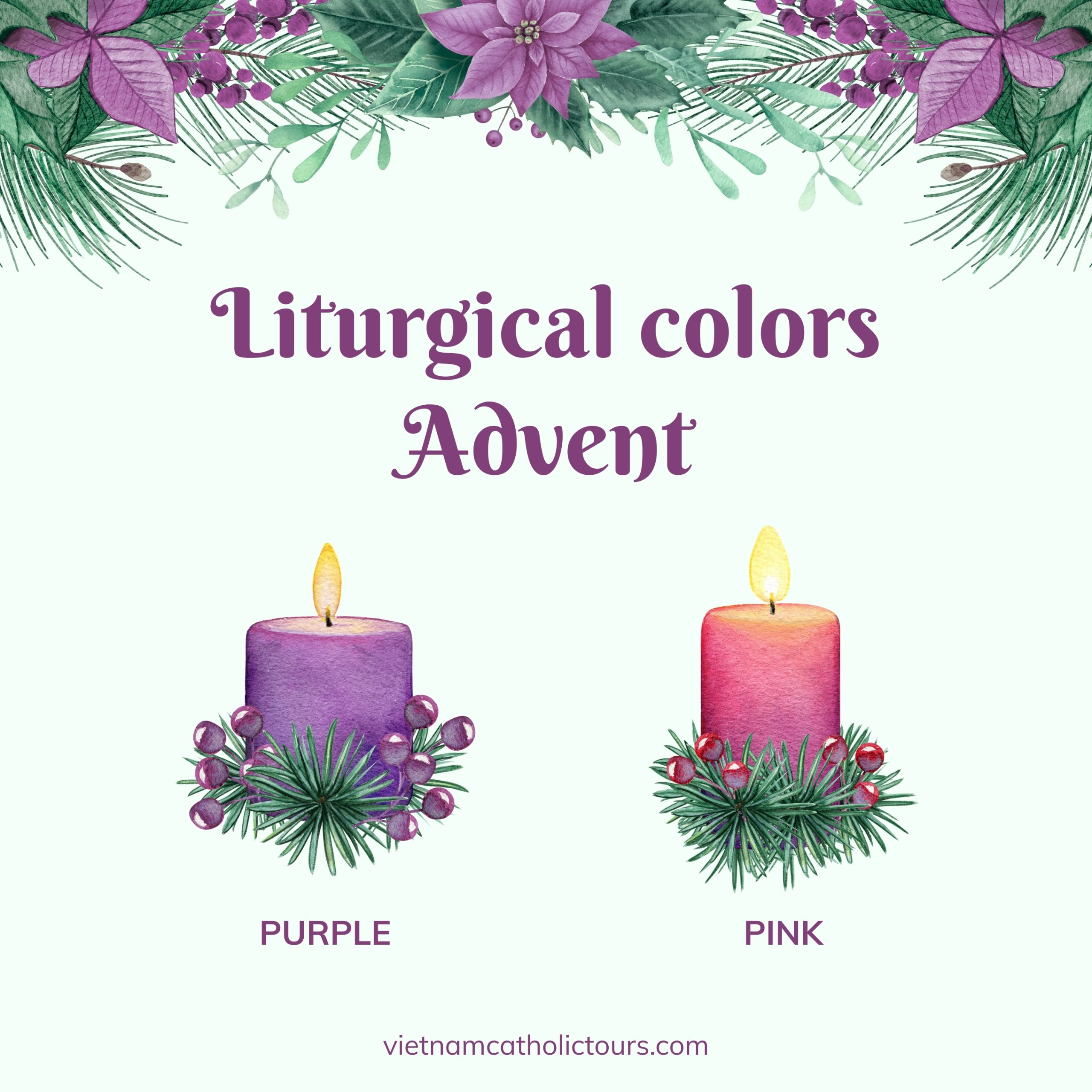 (Liturgical colors Advent)
In addition, special days and celebrations have their own liturgical colors:
- Red is used for feasts of martyrs and for celebrations of the Holy Spirit.
- White or black may be used for funeral Masses, depending on local tradition.
There is also a special custom in many places: on the Third Sunday of Advent, known as “Gaudete Sunday” or “Rejoice Sunday”, rose (pink) vestments may be used. The same rose color is also permitted on the Fourth Sunday of Lent (Laetare Sunday) (cf. GIRM 346f).
3. Is Advent a penitential season?
Many people tend to think of Advent as a penitential season, because the liturgical color is violet, similar to Lent, which is clearly a season of penance.
However, strictly speaking, Advent is not a penitential season in the same juridical sense as Lent. Surprising, isn’t it?
According to Canon 1250 of the Code of Canon Law, the days and times of penance in the universal Church are:
- All Fridays of the year.
- The entire season of Lent.
Although local bishops’ conferences and diocesan bishops may establish additional days of penance, this list is already complete for the Latin Church, and Advent is not included.
That said, in pastoral practice, the Church still encourages the faithful to live Advent with a spirit of watchfulness, interior conversion, and spiritual preparation. However, the central focus of Advent remains hope and joyful expectation rather than strict penance.
4. When does Advent begin and end?
According to the “General Norms for the Liturgical Year and the Calendar” (no. 40), Advent begins with First Vespers (Evening Prayer I) of the Sunday that falls on or closest to 30 November, and it ends before Evening Prayer I of Christmas.
The Sunday closest to 30 November may fall between 27 November and 3 December, depending on the year.
For example, in 2025, the Sundays of Advent are:
- 30 November – First Sunday of Advent
- 7 December – Second Sunday of Advent
- 14 December – Third Sunday of Advent
- 21 December – Fourth Sunday of Advent
In the liturgy, Evening Prayer I of Sunday is usually prayed on Saturday evening. According to the Liturgy of the Hours, Evening Prayer may be celebrated just before the vigil Mass, and Evening Prayer I of solemnities and Sundays may be anticipated after the Mass of the preceding day (Saturday).
This means that Advent begins on Saturday evening sometime between 26 November and 2 December, and it ends on the evening of 24 December, when the Church celebrates Evening Prayer I of Christmas (25 December).
5. What is the role of the Sundays of Advent?
There are four Sundays in Advent. The “General Norms for the Liturgical Year and the Calendar” states that these are called the First, Second, Third, and Fourth Sundays of Advent (no. 41).
Each Sunday of Advent has a particular meaning and is often symbolized by a candle on the Advent wreath:
- First Sunday of Advent – the Candle of Hope: reminds us of the hope and expectation of the coming Savior.
- Second Sunday of Advent – the Candle of Faith / Word (Gospel): invites us to prepare our hearts to receive the Good News and preaching of Jesus Christ.
- Third Sunday of Advent – the Candle of Joy (Gaudete Sunday): the word “Rejoice” is the first word of the Entrance Antiphon for this day, highlighting the joy that the Lord is near.
- Fourth Sunday of Advent – the Candle of Peace: helps us prepare to welcome Jesus, the Prince of Peace, who brings true peace to the human heart.
The Church assigns a special importance to the Sundays of Advent. Because of their rank, the Sundays of Advent, Lent, and Easter take precedence over most other liturgical celebrations. As the norms explain, only solemnities of the highest rank may replace them, and if a solemnity falls on such a Sunday, it is usually transferred to Saturday (cf. no. 5, “General Norms for the Liturgical Year and the Calendar”).
6. What happens on the weekdays of Advent?
Not only the Sundays, but also the weekdays of Advent are a precious time of grace, and weekday Masses and homilies are particularly encouraged.
The “General Norms for the Liturgical Year and the Calendar” (no. 41) notes the special role of the weekdays from 17–24 December. These days form a more immediate preparation for the Nativity of the Lord.
This special character is expressed in:
- The readings from Sacred Scripture, which focus on the prophecies and events leading directly to the birth of Christ.
- The prayers, antiphons, and hymns used in the liturgy, which express the longing of the Church for the coming of the Messiah.
7. How is Advent celebrated in Vietnam?
During Advent, the sanctuary and altar in churches are decorated in a restrained and simple way, in harmony with the character of the season, so as not to express the full joy of Christmas too early (cf. GIRM 305).
Vietnamese Catholics celebrate Advent with many beautiful traditions that also carry the colors of local culture:
- Major churches and shrines such as Our Lady of La Vang, Phu Cam Cathedral in Hue, Notre-Dame Cathedral Basilica of Saigon, and St. Joseph’s Cathedral in Hanoi are decorated from early December with Nativity scenes, star lanterns, Christmas trees, and Advent wreaths.
- Many families and communities gather for evening prayers, pray the Rosary, and attend daily or more frequent Masses.
- Parishes often organize Christmas vigils, sacred music nights, Bible services, and charitable activities, such as visiting the poor, the sick, and those in difficulty.
- Visitors and pilgrims are welcome to attend Mass, and in some major parishes there may be Masses in English or people available to help with translation.
For international visitors, this is a wonderful opportunity to experience Advent and Christmas in Vietnam, and to witness a living Catholic faith in an Asian cultural setting.
8. How are music and the Gloria used during Advent?
During Advent, the use of the organ and other musical instruments is permitted, but should be moderate and in keeping with the character of the season, so as not to anticipate the full joy of Christmas (cf. GIRM 313).
As for the Gloria (“Glory to God in the highest”), it is not sung or recited at Masses during Advent, until the celebration of Christmas.
9. What personal devotions can we practice during Advent?
Besides the official liturgy, the Church also encourages personal and communal devotions during Advent, to help the faithful draw closer to God.
10. What is the meaning of the Advent wreath and candles?
The Advent wreath usually has four candles, and one more may be added in some places. One candle is lit on each Sunday of Advent as a sign of watchfulness, waiting, and prayer.
The origin of the Advent wreath goes back to an ancient custom of lighting candles during the dark winter months, asking for the return of the sun’s warmth and light. Christian missionaries transformed and purified this practice, using the Advent wreath as a symbol of waiting for the Christ Child, commemorating His birth and asking Him to enlighten and warm our hearts.
- The circular shape of the wreath expresses the fullness and eternity of God’s love, without beginning or end.
- The evergreen branches symbolize life and hope, reminding us that Christ is living and present among us.
- The four candles represent the four Sundays of Advent, usually three violet candles and one rose candle:
- The three violet candles signify watchfulness, conversion, and sacrifice, as we prepare our hearts to be worthy to receive the Christ Child.
- The rose candle, lit on the Third Sunday of Advent (Gaudete Sunday), symbolizes joy, because Christmas is near.
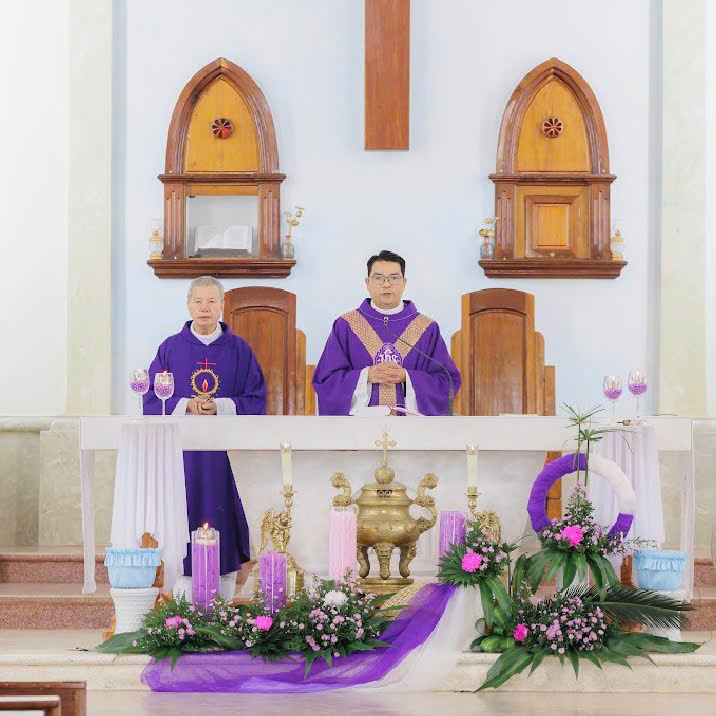 (Wreath and candles inside Tan Luong Parish Church – Cre: Archdiocese of Hue)
Advent is not only a time of inner preparation, but also an invitation to renew the hope and love that Jesus Christ brings to each of us and to the whole world.
If you are planning to visit Vietnam during this season and would like to experience Catholic life and Advent traditions here, Vietnam Catholic Tours will be glad to accompany you through meaningful pilgrimage programs, church visits, and trips to holy sites throughout the country.
 Thank you for taking the time to read this article. May you have an Advent filled with hope, peace, love, and the grace of Jesus Christ, our Savior.
Source: Vietnamese Bishops’ Conference.
Vietnam Catholic Tours